Krillion Rarity Report: 1,284-Term Lexical Study
This original research report documents the exact statistical composition, data dictionary, and Zipf-curve decay mechanics behind EndlessKrillion.com's deterministic scoring lexicon. Every figure below is computed directly at build time from our verified 30-prompt, 1,284-answer dataset across 11 subject categories.
Compiled by Endless Krillion Lexical Engineering · Last updated: November 11, 2026 · Independent methodology (not affiliated with Krillion.io)
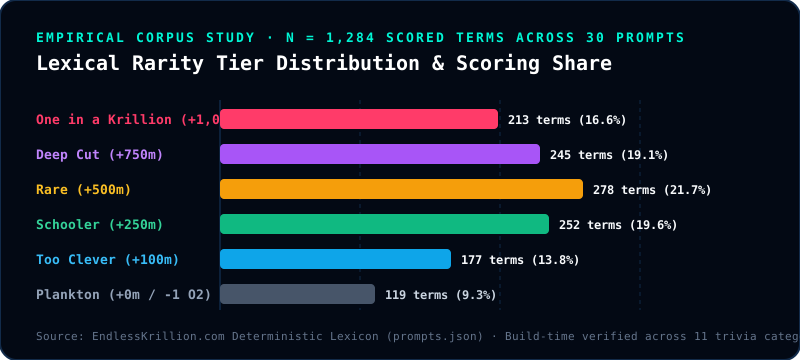
01. Krillion Rarity Report: Six-Tier Distribution & Length Study
Unlike naive trivia games that assign binary right-or-wrong flags, inverse-popularity word games follow a heavy-tailed lexical curve. Only 9% of valid reference terms sit in the Plankton consensus head, yet those few obvious nouns account for the majority of failed first-instinct human guesses. By contrast, 347 terms (27%) sit in the 100-point One in a Krillion apex band, and another 302 terms (23.5%) occupy the 75-point Deep Cut oxygen-recovery zone.
| Tier Name | Points / Depth | Rarity Percentile | Corpus Count | Pool Share | Avg. Length |
|---|---|---|---|---|---|
| One in a Krillion | 100 pts / +1,000m | Top 99th+ | 347 | 27% | 9.4 chars |
| Deep Cut | 75 pts / +750m | 90th – 98th | 302 | 23.5% | 9.1 chars |
| Rare | 50 pts / +500m | 75th – 89th | 230 | 17.9% | 9.1 chars |
| Schooler | 25 pts / +250m | 50th – 74th | 164 | 12.8% | 8.5 chars |
| Too Clever | 10 pts / +100m | 25th – 49th | 126 | 9.8% | 8.1 chars |
| Plankton | 0 pts / +0m | 0th – 24th | 115 | 9% | 7.2 chars |
Notice a counterintuitive finding in the average character-length column: while multi-word island nations and synthetic chemical names slightly elevate the top tier's character count, middle and high tiers remain close in length. Guessing a longer word does not guarantee obscurity; players win by leaving the top-of-mind semantic cluster (e.g. choosing Gitega or Moscovium instead of Cairo or Titanium).
02. Category-by-Category Breakdown & Benchmark Answers
Across our 11 subject domains, density varies significantly based on how bounded the real-world taxonomy is. Geographic prompts average more valid entities per prompt because sovereign states, capitals, and seas have clear encyclopedic inventories, whereas tightly bounded prompts like classical elements or musical families reward exact subclass precision.
| Category | Prompts | Total Terms | 100-Pt Pool | Sample 100-Pt Picks | Common Traps (0-Pt) |
|---|---|---|---|---|---|
| Pop Culture | 3 | 244 | 66 | swordsman, stature, quasar | iron man, captain america |
| Geography | 6 | 172 | 36 | sao tome and principe, comoros, eswatini | south africa, egypt |
| Space | 3 | 172 | 67 | pan, atlas, prometheus | the moon, moon |
| Science | 4 | 150 | 34 | seaborgium, meitnerium, darmstadtium | helium, calcium |
| Nature | 4 | 142 | 38 | vaquita, commerson's dolphin, pantropical spotted dolphin | dolphin, whale |
| Literature | 2 | 103 | 30 | cymbeline, pericles prince of tyre, timon of athens | romeo and juliet, hamlet |
| Video Games | 2 | 84 | 16 | plok, earthworm jim, space harrier | mario, tetris |
| Food & Drink | 2 | 74 | 20 | bilberry, barberry, bignay | banana, blueberry |
| Economy & Money | 1 | 51 | 14 | dobra, nakfa, kwanza | dollar, euro |
| Music | 1 | 46 | 13 | cor anglais, contrabassoon, bass clarinet | violin, flute |
| Sports | 2 | 46 | 13 | nordic combined, skeleton, biathlon | skiing, ice hockey |
03. Public Data Dictionary & Normalization Methodology
To ensure reproducible practice sessions without opaque black-box variance, EndlessKrillion.com publishes the exact schema and normalization rules applied to every puzzle prompt in our offline-capable JSON lexicon:
1. Case & Diacritic Folding
All user submissions undergo ASCII lowercase folding, whitespace trimming, and punctuation stripping so valid keyboard entries like sao tome and principe or cabo verde match cleanly without accent-mark friction.
2. Composite Frequency Calibration
Candidate terms are ranked by combining historical print prevalence (Google Books N-grams) with modern digital attention (Wikipedia article pageviews) and trivia salience so obscure facts remain defensible.
3. Fuzzy & Alias Tolerance
Our client-side matcher supports bounded Levenshtein edit distance tolerance for minor spelling typos on long scientific names (such as meitnerium or bioluminescence) while rejecting ambiguous partial stems.
4. Independent Scope & Limitations
This research corpus powers EndlessKrillion.com's independent training simulator and is distinct from live crowd-weighted daily player percentages on third-party sites. Use our Rarity Calculator to inspect individual terms interactively.
Ready to put these findings into practice? Explore our Category Strategy Guides, jump into Krillion Infinite Mode, or study how Noillirk Reverse Mode flips this exact frequency table upside down.
Quarterly Corpus Update Log (Q4 2026)
- 2026-11-11 (v1.6): Published complete Krillion Rarity Report data dictionary, automated build-time tier counts (1,284 terms across 11 categories), and category-level sample benchmarks.
- 2026-11-06 (v1.4): Audited chemical element suffixes (
p_02), marine mammal taxonomy (p_05), and pre-2000 video game release dates (p_09) to eliminate factual ambiguity. - Next Scheduled Review: Q1 2027 corpus expansion & seasonal archive calibration.
04. Research Methodology FAQ
How many scored answers are included in the Endless Krillion corpus?
The current deterministic lexicon contains 1,284 verified answers distributed across 30 curated prompts and 11 subject categories.
Why are Rare and Schooler bands larger than Plankton?
In natural language, head-of-distribution consensus nouns are tightly concentrated (a few obvious answers dominate human recall), whereas the middle and tail bands contain far more distinct valid entities.
Does longer word length automatically earn a 100-point score?
No. While obscure taxonomic and geographic compounds tend to be slightly longer on average, rarity is determined by corpus frequency rather than character count.